
Research
AI Agent Security
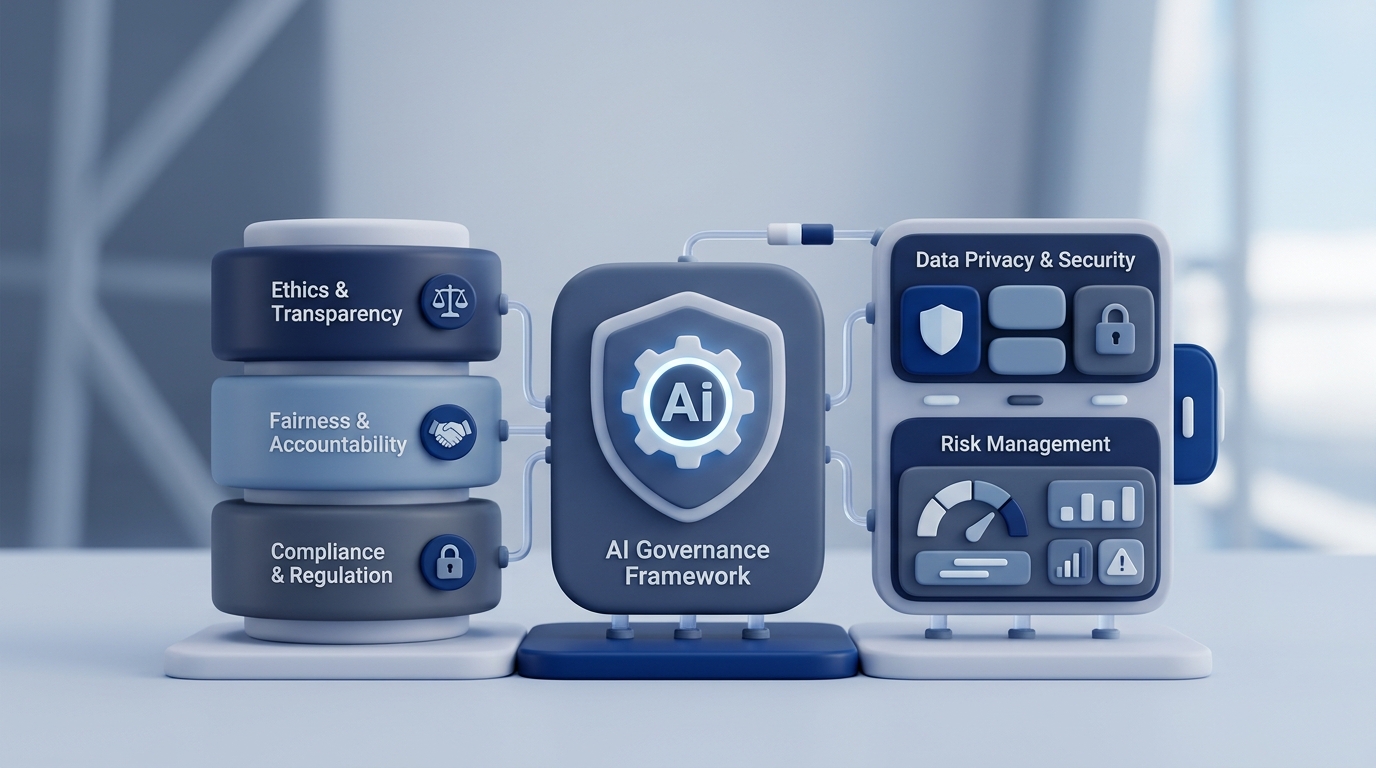

Enterprise AI governance has moved from theoretical framework to operational necessity. Organizations deploying AI systems at scale now face regulatory requirements that demand documented controls, audit trails, and continuous monitoring. The shift is particularly acute in regulated industries where compliance failures carry financial penalties and reputational damage. AI governance best practices provide the policies, controls, and operational frameworks that ensure AI systems remain secure, reliable, and compliant throughout their lifecycle. For security officers and compliance teams, the question is no longer whether to implement governance but how to build programs that protect the organization while enabling AI innovation.
Every credible governance program rests on five principles that address documented failure modes: fairness, transparency, accountability, privacy, and security. These principles translate into operational controls that prevent bias in decision-making systems, provide explainability for consequential outputs, establish clear ownership for AI outcomes, protect sensitive data, and defend against adversarial attacks.
Three external frameworks define structural expectations for enterprise AI governance. The NIST AI Risk Management Framework (AI RMF 1.0) establishes a four-function approach: Govern, Map, Measure, and Manage. The NIST Generative AI Profile (AI 600-1), published July 26, 2024, adds twelve generative-AI-specific risk categories and more than 400 management actions on top of the core framework. ISO/IEC 42001:2023 provides the international standard for AI management systems.
Regulated industries face layered compliance requirements. Financial services firms operate under SR 11-7 validation requirements and the 2026 SR 26-2 guidance for AI systems. Life sciences organizations need audit-grade traceability for FDA submissions under 21 CFR Part 11, which requires validated software with complete audit trails. Healthcare organizations must maintain GxP compliance with documented, reproducible, and auditable data lifecycles. The EU AI Act implementation is staged, with obligations for general-purpose AI models beginning in 2025 and high-risk system requirements extending through 2027-2028.
The most effective governance approach implements controls as native platform capabilities rather than separate oversight layers. Role-based access controls restrict access to sensitive datasets and models. Environment separation keeps experimentation isolated from production systems. Deployment approvals and automated policy checks prevent unauthorized releases. When governance operates as infrastructure rather than process theater, compliance becomes a feature of the development workflow.
The single most common cause of stalled AI governance programs is unclear executive ownership. Successful programs establish a Chief AI Officer (CAIO), AI ethics committee, or dedicated governance team with executive sponsorship and cross-functional authority. This structure provides a single point of accountability for AI risk management and regulatory compliance.
Governance programs require defined roles across the AI lifecycle. Data scientists need clear guidelines for model development, including approved frameworks, data sources, and validation requirements. Platform administrators enforce access controls, monitor system usage, and maintain audit logs. Compliance teams review AI applications against regulatory requirements and document evidence for audits. Security teams assess vulnerabilities and implement runtime defenses.
AI governance differs from data governance in scope and focus. Data governance addresses how organizations collect, store, and use data assets. AI governance extends these controls to cover model development, deployment, and operation. The two disciplines intersect at data quality, privacy, and lineage, but AI governance adds concerns about model behavior, output validation, and autonomous decision-making.
Building the program structure starts with an AI inventory. Organizations must identify all AI systems in use, including shadow AI deployed without IT approval. For each system, document the business purpose, data sources, model architecture, decision authority, and regulatory classification. This inventory becomes the foundation for risk assessment and control implementation.
Policy development translates principles into enforceable rules. Policies should cover data minimization, requiring systems to access only the data necessary for their function. Output validation policies mandate human review for consequential decisions in domains where AI hallucinations can cause harm. Incident response policies establish escalation paths, rollback procedures, and documentation requirements when systems produce errors. Effective programs embed policy checks into deployment pipelines and runtime monitoring.
Only 31% of organizations report being fully equipped to control and secure agentic AI systems, even as 83% plan to deploy them according to the Cisco AI Readiness Index 2025. This readiness gap represents a critical vulnerability. AI agents differ fundamentally from traditional AI applications because they plan, reason, invoke external tools, modify state, and execute multi-step workflows with minimal human intervention at each step.
Runtime defense provides continuous monitoring and control as AI systems operate in production environments. Traditional governance approaches focus on pre-deployment validation: testing models, reviewing code, and documenting compliance before release. These controls remain necessary but insufficient for systems that make dynamic decisions based on real-time inputs. Runtime defense monitors agent behavior, validates outputs against policy constraints, and intervenes when systems exceed authorized boundaries. This capability is essential for agent readiness in regulated environments.
Agents introduce specific security challenges that require specialized controls. Tool invocation allows agents to call external APIs, query databases, or execute code. Without runtime validation, agents can access unauthorized resources or trigger unintended actions. State modification enables agents to update records, change configurations, or initiate transactions. Governance frameworks must track these modifications and maintain rollback capability. Multi-step reasoning allows agents to chain actions toward goals. Organizations need visibility into agent decision paths to identify when systems pursue objectives that conflict with policy or safety requirements.
Output validation becomes critical when AI systems generate content that influences consequential decisions. Large language models can produce convincing but factually incorrect information through hallucination. In finance, healthcare, or legal services, relying on hallucinated outputs creates professional liability and patient harm risks. Governance frameworks mandate fact-checking mechanisms, human review for high-stakes decisions, and audit trails that document validation steps.
Incident response for AI agents requires capabilities beyond traditional IT incident management. When an agent makes an error, organizations need to identify what happened, why the agent chose that action, and how to reverse the effects where possible. This requirement demands detailed logging of agent reasoning, tool invocations, and state changes. Rollback procedures must account for cascading effects when agents have triggered multiple downstream actions.
Compliance has shifted from policy statements to evidence and auditability. Regulators and auditors now expect organizations to demonstrate continuous compliance through logs, access reviews, and data protection impact assessments. Static documentation of governance policies no longer satisfies regulatory requirements.
Continuous monitoring helps organizations identify new risks, improve accountability, and maintain compliance as AI environments evolve. Monitoring systems track model performance metrics, detecting drift when accuracy degrades or bias increases. Access logs record who interacts with AI systems and what data they access. Policy violation alerts flag when systems attempt unauthorized actions. Usage analytics identify shadow AI and unapproved deployments.
Audit-ready evidence requires structured documentation across the AI lifecycle. Model development documentation includes training data sources, feature engineering decisions, validation results, and bias testing outcomes. Deployment documentation records approval workflows, environment configurations, and access control settings. Operational documentation captures runtime logs, incident reports, and remediation actions. Organizations should maintain this documentation in systems that provide tamper-evident storage and version control.
Financial services organizations face specific validation requirements under SR 11-7 and the upcoming SR 26-2 guidance. These regulations require documented model risk management processes, independent validation of high-risk models, and ongoing performance monitoring. Life sciences organizations must demonstrate GxP compliance with validated systems, complete audit trails, and documented change control. Government contractors need FedRAMP authorization with continuous monitoring and incident reporting.
Data protection impact assessments (DPIAs) have become standard practice for AI systems that process personal data. DPIAs document what data the system collects, how it uses that data, what risks the processing creates, and what controls mitigate those risks. Under GDPR and similar privacy regulations, organizations must complete DPIAs before deploying high-risk AI systems.
Privacy controls extend beyond DPIAs to operational data protection. Data minimization reduces risk by limiting AI systems to the minimum data necessary for their function. Masking and anonymization techniques protect sensitive information while preserving analytical utility. Access controls enforce need-to-know principles, restricting data access to authorized users and systems. Retention policies ensure that AI systems delete data when no longer required.
Organizations should approach AI governance implementation as a phased program rather than a single project. The first phase establishes foundational policies and governance structure. This includes defining the five core principles, assigning executive ownership, forming cross-functional governance teams, and documenting initial policies. Organizations should complete an AI inventory during this phase to understand the current state and identify high-risk systems requiring immediate attention. This foundation typically requires three to six months depending on organizational complexity.
The second phase implements technical controls and monitoring capabilities. Organizations deploy role-based access controls, environment separation, and deployment approval workflows. Logging infrastructure captures the telemetry required for compliance monitoring and incident investigation. Policy enforcement mechanisms integrate with development pipelines and runtime environments. Technical implementation typically spans six to twelve months as organizations integrate controls across platforms and applications.
The third phase operationalizes continuous compliance and runtime defense. Monitoring systems begin tracking policy violations, performance drift, and security events. Incident response procedures are tested and refined through tabletop exercises. Audit documentation processes mature to produce evidence on demand. Organizations expand governance coverage from initial high-risk systems to the broader AI portfolio.
Measuring governance maturity helps organizations assess progress and identify gaps. Initial maturity focuses on policy existence and awareness. Intermediate maturity demonstrates consistent policy enforcement and basic monitoring. Advanced maturity shows automated controls, continuous compliance, and proactive risk management. Organizations should assess maturity across multiple dimensions: policy coverage, technical controls, monitoring capabilities, incident response readiness, and audit preparedness.
Integration with existing GRC tools and processes prevents governance silos. AI governance should connect to enterprise risk management frameworks, compliance management systems, and security operations platforms. This integration provides unified visibility into AI risks alongside other enterprise risks.
The path from policy to operational governance requires sustained executive commitment and cross-functional collaboration. Organizations that succeed treat governance as an enabler of AI innovation rather than a compliance burden. They build controls into platforms rather than layering oversight processes on top of development teams. They invest in automation to reduce manual compliance work and accelerate deployment cycles. Most importantly, they recognize that governance is not a one-time implementation but an ongoing program that must evolve with technology, regulations, and business requirements. For enterprises in regulated industries, mature ai governance best practices are the foundation for deploying AI systems that deliver business value while managing risk and maintaining compliance.